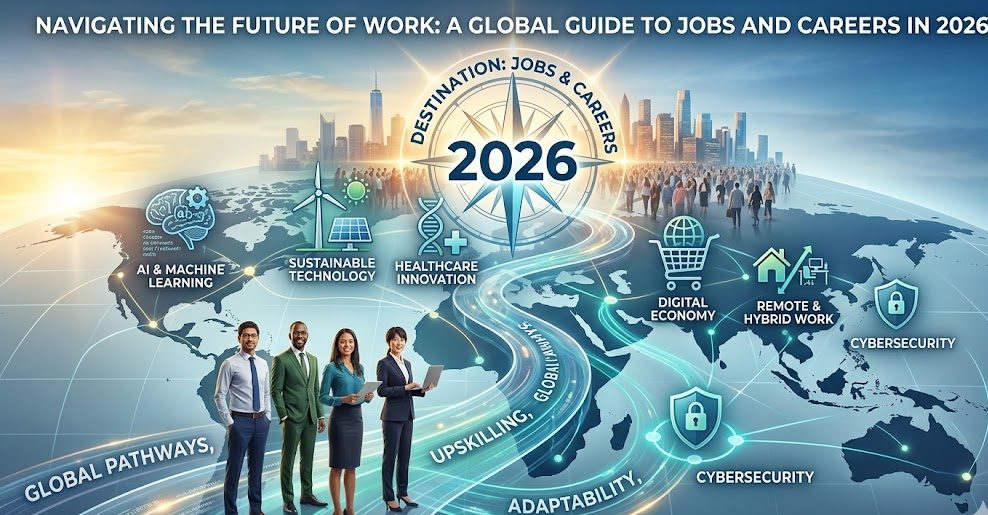
The global job market is currently undergoing a “Great Reset.” Driven by the rapid integration of Artificial Intelligence (AI), the normalization of remote work, and a shift toward a skills-first economy, the way we define a “successful career” has fundamentally changed. In 2026, staying relevant requires more than just a degree; it requires adaptability, continuous upskilling, and a global mindset.
This 1,000-word comprehensive guide explores the high-demand industries of the future, essential soft skills, and strategic advice for building a career that is both financially rewarding and future-proof.
1. The AI Revolution: Threat or Opportunity?
The biggest question in 2026 is: “Will AI take my job?” While AI is automating routine tasks, it is also creating entirely new categories of work.
- The Displacement Reality: Roles involving data entry, basic administrative tasks, and manual reporting are being handled by AI agents.
- The New Frontier: High-paying roles like AI Prompt Engineers, Ethical AI Auditors, and Machine Learning Trainers are in massive demand.
- The Strategy: Instead of competing with AI, successful professionals are learning to “co-pilot” with it. Using AI to boost your productivity is the number one skill in the modern workplace.
2. Top High-Demand Careers in 2026
If you are looking to switch careers or starting fresh, these industries offer the highest growth potential and salary packages worldwide:
A. Sustainability and Green Energy
With global governments pushing for “Net Zero” targets, there is a massive shortage of talent in Renewable Energy, Carbon Accounting, and Sustainable Supply Chain Management.
B. Healthcare and Bio-Technology
As the global population ages, the demand for specialized nurses, geriatric care experts, and biotechnologists is skyrocketing. Healthcare is one of the few sectors that remains “recession-proof.”
C. Cybersecurity and Data Privacy
In a world of digital finance and crypto, protecting data is a national security priority. Companies are willing to pay top dollar for Cybersecurity Architects who can prevent sophisticated AI-driven cyberattacks.
D. The Creative and Experience Economy
As automation handles technical tasks, human creativity becomes more valuable. Content strategists, UX (User Experience) designers, and “Experience Architects” for the Metaverse are seeing significant career growth.
3. The Shift to “Skills-First” Hiring
Major tech giants like Google, Amazon, and IBM have officially de-emphasized university degrees in their hiring processes. They are now looking for Micro-Credentials.
- What are Micro-Credentials? These are short, intensive certifications in specific tools (e.g., AWS Cloud Certification, Google Data Analytics, or Python Programming).
- The Portfolio is the New Resume: In 2026, showing what you have built (via GitHub, a personal blog, or a portfolio site) is more effective than listing where you studied.
4. Mastering the Hybrid and Remote Work Schemes
The “Digital Nomad” lifestyle is no longer a dream; it’s a standard employment model. Many governments now offer Remote Work Visas (like Spain, Dubai, and Portugal), allowing you to work for a US-based company while living on a beach in Bali.
- Key Challenge: Remote work requires high levels of self-discipline and “asynchronous communication” skills (writing clearly so others can understand your work without a meeting).
- Networking: In a remote world, your network is your net worth. Using platforms like LinkedIn effectively to build global connections is crucial.
5. Essential Soft Skills: The “Human Advantage”
As machines get smarter, the skills that make us human become our greatest assets. Employers are prioritizing:
- Emotional Intelligence (EQ): The ability to lead teams, resolve conflicts, and show empathy.
- Critical Thinking: Analyzing information objectively and making decisions when there is no “clear” answer.
- Adaptability (AQ): How fast can you learn a new tool and unlearn an old one? Your “Adaptability Quotient” is now more important than your IQ.
6. Career Pivot: How to Change Paths in 2026
Many people are leaving “burnt-out” industries like traditional retail or banking to move into tech or creative fields. Here is the framework for a successful pivot:
- Identify Transferable Skills: If you were a teacher, you have excellent “Communication” and “Project Management” skills that are vital for a Corporate Trainer role.
- The “Bridge” Project: Start a side project or freelance gig in your target field before quitting your current job.
- Upskill While You Work: Use platforms like Coursera or LinkedIn Learning to get certified during your weekends.
7. Global Salary Trends and Negotiation
In 2026, salaries are becoming more transparent. Websites like Glassdoor and specialized “Salary Calculators” help workers know their worth.
- Negotiation Tip: Don’t just negotiate for salary. Negotiate for “Learning Budgets,” “Work-from-Home Stipends,” and “Equity/ESOPs.”
- The “Side-Hustle” Economy: Most modern professionals have at least one secondary income stream—whether it’s a YouTube channel, a newsletter, or consulting.
8. Mental Health and Work-Life Harmony
The “Hustle Culture” of the past decade is being replaced by a focus on “Sustainable Productivity.” Governments in Europe are even testing 4-day work weeks.
- Why it matters: Burnout is the leading cause of career failure. Choosing a company that values mental health and offers “Wellness Schemes” is a strategic career move.
9. Conclusion: Taking the Driver’s Seat
In 2026, you are the CEO of your own career. You cannot rely on a single company to take care of you for 30 years. By staying curious, building a global network, and constantly updating your skill set, you can navigate the complexities of the modern job market with confidence.
The future of work belongs to those who are “Life-Long Learners.”