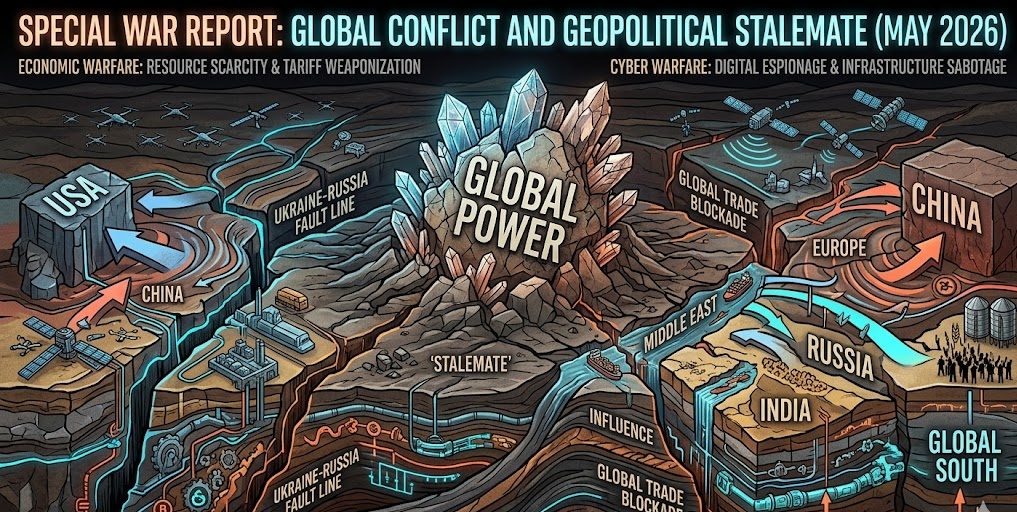
As of May 14, 2026, the global security landscape is defined by “The Great Fragmentation.” Traditional warfare has merged with high-tech sabotage, creating a world where the line between “ceasefire” and “active combat” is almost invisible. This report analyzes the most critical war zones and the technological shifts defining 2026.
1. The West Asia Conflagration: Operation Epic Fury
The most violent flashpoint of 2026 remains the direct conflict between the US-Israel Alliance and the Iranian Axis of Resistance.
- The Decisive Strike: On February 28, 2026, a joint US-Israeli operation (codenamed Epic Fury) successfully targeted the Iranian leadership in Tehran, killing Supreme Leader Ali Khamenei. This move was intended to achieve rapid regime change but instead triggered a massive regional escalation.
- The Retaliation: Iran responded with “The Torrent,” launching thousands of drones and ballistic missiles at Israel and US bases in Bahrain, Qatar, and the UAE.
- The Strait of Hormuz Blockade: Following the failure of the “Islamabad Peace Talks” in late April, the conflict has shifted to a naval blockade. The US Navy is blockading Iranian ports, while Iran has effectively shut down the Strait of Hormuz, restricting global oil flow and threatening the US 5th Fleet’s headquarters in Manama.
2. The Ukraine-Russia Front: Five Years of Attrition
The war in Ukraine has evolved into a “War of Infinite Drones.” While the front lines in the Donbas have moved only slightly in 2026, the intensity of strikes has reached a historic peak.
- Aerial Dominance: In March 2024, Russia launched its largest drone barrage of the entire war (nearly 900 units in 24 hours). By May 2026, both sides are using Swarm AI, where hundreds of drones coordinate their attacks autonomously to overwhelm air defenses.
- Russian Stagnation: Despite Putin’s claims of success, the Russian rate of advance has declined every month since October 2025. Ukraine has successfully shifted to a “Mid-Range Strike Campaign,” targeting Russian oil terminals and repair units deep inside Belgorod and Crimea.
- The Ceasefire Game: Russia recently announced a temporary ceasefire to mark World War II Victory Day (May 9), but reports from the Institute for the Study of War (ISW) indicate that fighting continues in northern Kharkiv and east of Slovyansk.
3. The New Weapons of 2026: AI and Hypersonics
Warfare in 2026 is no longer just about tanks and soldiers; it is about Agentic AI and Space Dominance.
- Autonomous Agentic AI: Military systems now utilize AI agents that don’t just follow instructions but adapt to battlefield changes in real-time. These agents manage everything from predictive maintenance of fighter jets to executing offensive cyber-strikes on enemy power grids.
- Hypersonic Deployment: For the first time, hypersonic missiles (traveling at speeds above Mach 5) have become a standard part of the theater of war. These weapons are nearly impossible to intercept with current 2024-era missile defense systems like the Patriot or S-400.
- Space as a Battlefield: Conflict has moved into low-earth orbit. In May 2026, Space Situational Awareness is the top priority for major powers, with specialized “inspector satellites” used to track and potentially disable adversary communication networks.
4. Flashpoints for the Remainder of 2026
While West Asia and Ukraine are currently “hot,” three other regions are on a “High Alert” status:
- The South China Sea: US and Chinese naval assets are in a constant state of “Shadowing.” The race to secure Semiconductor Supply Chains has turned the waters around Taiwan into a high-stakes standoff.
- The Sahel Region (Africa): A surge in non-state armed conflict has turned parts of Sudan and Mali into a testing ground for cheap, commercial drone technology used by various factions.
- The Arctic Frontier: As the ice melts, NATO and Russia are competing for new shipping routes and mineral deposits, leading to increased military buildup in the “High North.”
5. Summary: The Cost of Global Conflict
The economic toll of these wars is staggering. In May 2026, many global snack and consumer goods packages have turned black-and-white because the war in West Asia has depleted the global supply of specialized inks and chemical components.
| Conflict | Key Actors | Status (May 2026) | Primary Threat |
|---|---|---|---|
| West Asia | US, Israel vs. Iran, Hezbollah | Naval Blockade / Ceasefire holding poorly | Global Energy Crisis |
| Eastern Europe | Ukraine vs. Russia | Attrition / Trench Warfare | Nuclear Brinkmanship |
| Indo-Pacific | US vs. China | Cold War / Standoff | Semiconductor Shortage |
| Cyber Realm | State-sponsored Hackers | Continuous Attacks | Infrastructure Collapse |
Export to Sheets
Conclusion
The “Special War” of 2026 is a multi-dimensional struggle. It is being fought in the trenches of Ukraine, the waters of the Persian Gulf, and the servers of Silicon Valley. As major powers turn inward to protect their own “Digital Sovereignty,” the global community faces a turbulent future. The goal for the latter half of 2026 remains de-escalation, but with the weaponization of hunger and energy, the path to peace is more complex than ever.