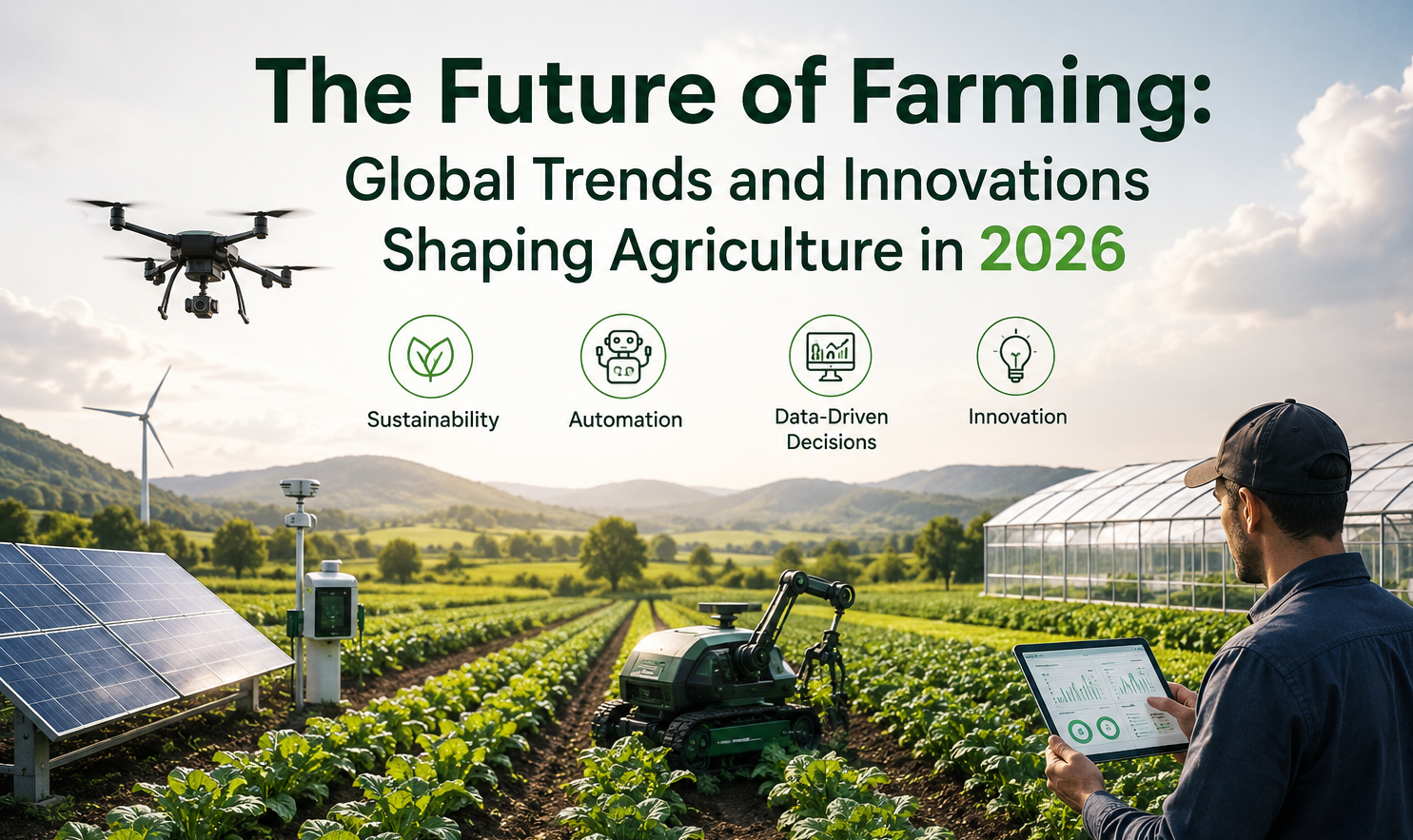
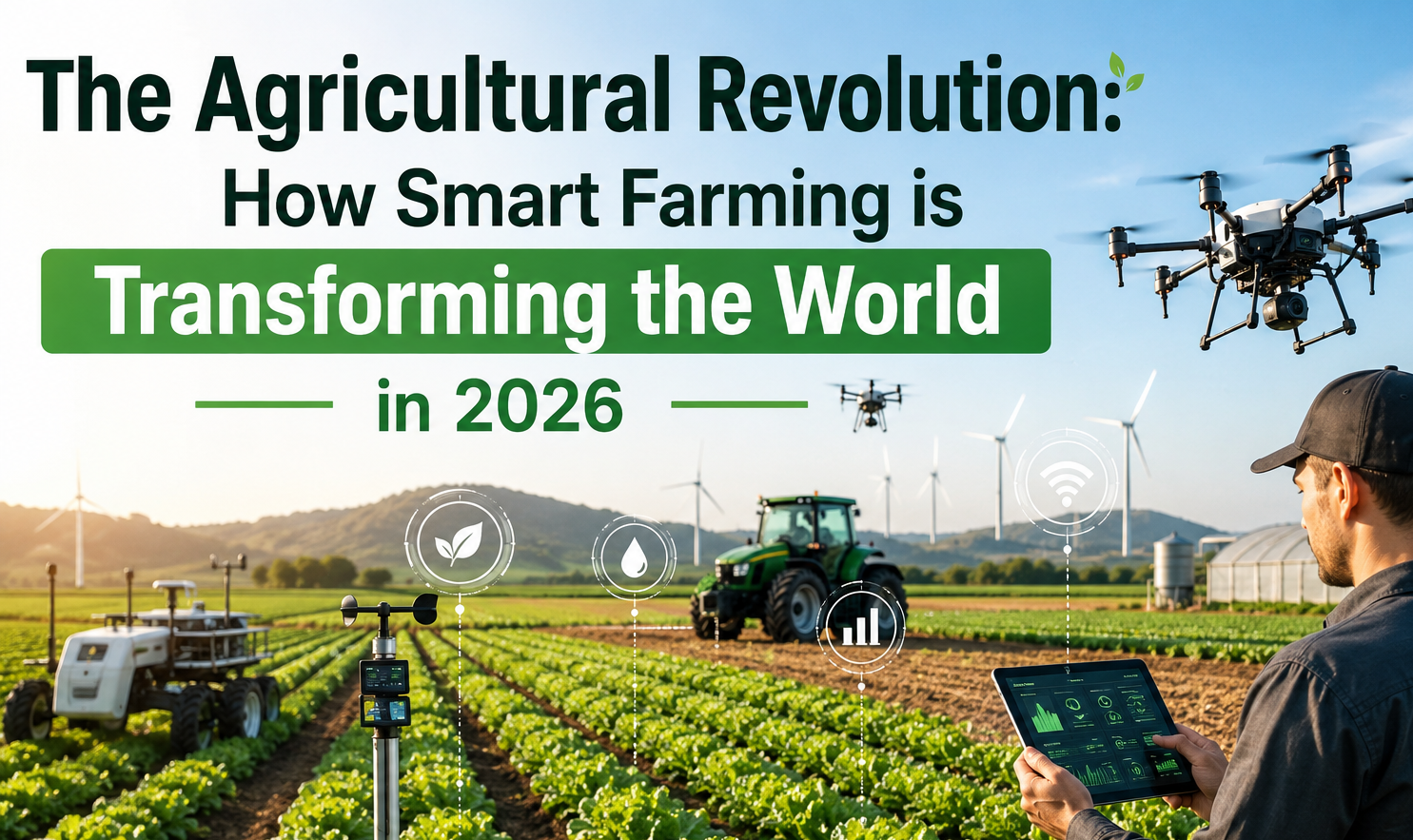
The global agricultural landscape is currently undergoing its most significant transformation in a century. As we navigate through 2026, the traditional image of farming—dependent entirely on seasonal whims and manual labor—is being replaced by a high-tech, data-driven industry. With the global population surging and climate patterns becoming increasingly unpredictable, “Smart Farming” has transitioned from a futuristic concept into a global necessity for food security and sustainability.
This evolution is driven by a convergence of artificial intelligence, satellite technology, and a renewed commitment to the earth’s soil. Here is how the world is farming in 2026.
1. AI-Driven Decision Intelligence
In 2026, the most powerful tool on a farm isn’t the tractor; it’s the “Decision Copilot.” Artificial Intelligence has moved far beyond simple data collection. Today’s AI systems act as real-time field partners for farmers, analyzing trillions of data points from soil sensors, weather stations, and satellite imagery.
These “Human-in-the-Loop” systems don’t just show data; they provide field-by-field priorities. An AI copilot can now predict a pest outbreak five days before it happens or suggest a variable-rate fertilizer plan that saves a farm 15% in costs while increasing yield. For mid-sized operations, modular AI tools have made this tech affordable, allowing them to manage risks that were previously invisible.
2. The Rise of Autonomous “Field-Ready” Robotics
Labor shortages have historically been the Achilles’ heel of agriculture. In 2026, robotics and automation have reached a turning point in accessibility. Autonomous tractors and weeding robots are now widely used across North America, Europe, and parts of Asia.
These robots do more than just drive themselves; they use computer vision to identify and pull individual weeds, reducing the need for chemical herbicides by up to 90%. On the ground, multi-robot coordination systems allow a fleet of small, lightweight robots to manage a field together, preventing the soil compaction often caused by heavy, traditional machinery.
3. Vertical Farming: Reimagining the Urban Food System
As arable land becomes scarcer and cities grow denser, “Vertical Agriculture” has become an integral part of urban planning. In 2026, vertical farms are projected to use up to 95% less water than traditional open-field agriculture.
By stacking crops in climate-controlled indoor environments, urban centers are now producing fresh, pesticide-free leafy greens and berries just miles—or even blocks—from where they are consumed. These systems use advanced LED recipes to mimic the sun, ensuring year-round production independent of the weather outside. By 2026, rooftop and community vertical farms are not just commercial ventures but social hubs that improve local air quality and create green jobs in metropolitan areas.
4. Regenerative Agriculture and the Carbon Economy
Modern farming is no longer just about taking from the land; it’s about healing it. Regenerative agriculture has taken the global stage in 2026, focusing on restoring soil health and biodiversity.
Core practices such as no-till farming and cover cropping have become mainstream, supported by government incentives and climate-focused investors. By keeping the soil undisturbed, farmers are turning their fields into “carbon sinks,” trapping CO2 underground to help mitigate global warming. Blockchain-based tracking now creates “Compliance-Ready” records of these carbon levels, allowing farmers to earn significant passive income by selling carbon credits to international corporations.
5. IoT and the “Connected” Supply Chain
The Internet of Things (IoT) has connected every stage of the food journey. In 2026, IoT-powered agriculture is forecast to boost global farm efficiency by over 35%.
- Satellite Monitoring: High-resolution satellite constellations provide real-time field health analysis, allowing farmers to spot issues across thousands of acres instantly.
- Smart Irrigation: Automated valves and drip systems respond to real-time soil moisture probes, applying water only where and when it is needed, which is critical in drought-prone regions.
- Traceability: From “Field to Fork,” every batch of produce is tracked via digital sensors. If a quality defect is detected, blockchain records allow for rapid, transparent recalls, ensuring consumer safety and reducing global retail food waste by more than 15%.
6. Small-Scale Empowerment through Connectivity
Perhaps the most impactful change in 2026 is the democratization of technology. Connectivity and interoperability have reached a stage where even small-scale farmers in developing nations can access high-level insights via simple smartphone apps.
Global schemes now provide “Virtual Advisory Support” at scale, giving a farmer with just two acres access to the same weather forecasting and pest detection models used by industrial-sized operations. This “Connected Intelligence” is closing the productivity gap and empowering a new generation of tech-savvy farmers worldwide.
Conclusion: A New Era of Abundance
The farming industry in 2026 is a testament to human ingenuity. By blending ancient ecological wisdom with cutting-edge digital intelligence, the world is creating a food system that is more resilient, transparent, and sustainable than ever before. As we continue to innovate, the farmers of 2026 are proving that we can feed a growing planet while simultaneously restoring the health of our environment.