As we navigate through the mid-point of 2026, the world is witnessing a shift in the global order. From the high-stakes conflict in West Asia to the rapid integration of AI into our daily lives, the news of today is shaping the history of tomorrow. This guide covers the biggest headlines, war-room strategies, and future outlooks for a worldwide audience.
1. West Asia: The Iran-Israel War and the Energy Crisis
The biggest news dominating the headlines in May 2026 is the direct conflict in the Middle East, primarily involving Iran and Israel. This isn’t just a regional fight; it has become a global energy emergency.
- The Strait of Hormuz Chokepoint: Iran’s recent assertion of sovereignty over the Strait of Hormuz has sent shockwaves through the global economy. As nearly 20% of the world’s oil flows through this narrow passage, its closure (even partial) has triggered a massive energy price shock.
- War Room Updates: US Central Command (CENTCOM) remains on high alert, recently striking military facilities in the region after inbound threats to naval assets. While the US claims it “does not seek escalation,” the reality on the ground is tense, with Israel and Iran locked in a cycle of retaliatory strikes.
- India’s Peace Role: Interestingly, India has emerged as a major peace mediator. Prime Minister Modi’s government is actively engaging with Tehran and Washington to de-escalate the situation, even as it advises Indian citizens to work from home and avoid foreign travel to save on energy costs during this crisis.
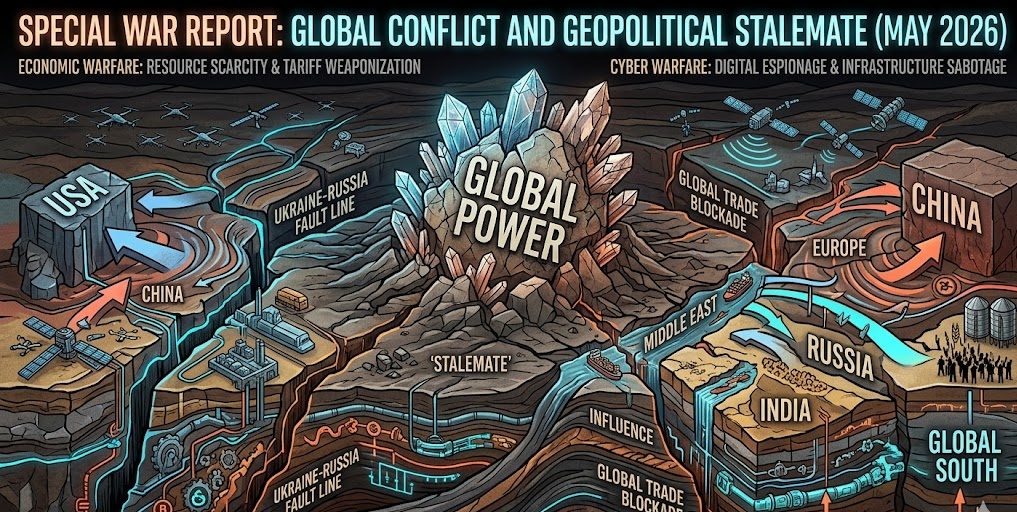
2. Ukraine-Russia: The Search for a “Gerhard Peace”
The war in Ukraine has entered its fifth year. While the frontlines have become somewhat static, the diplomatic front is heating up.
- Peace Talks Mediation: Former German Chancellor Gerhard Schroeder has been proposed as a potential pick for peace talks. The West remains divided on whether this move is acceptable, but the global “War Fatigue” is pushing leaders toward finding a functional balance.
- Humanitarian Impact: Russia continues heavy strikes on infrastructure, with May 2026 seeing some of the longest missile barrages since the start of the war. The goal for 2026 is a negotiated ceasefire, though both sides remain deeply entrenched in their territorial demands.
3. The Future Outlook: Rising Tensions in Asia
While West Asia and Europe are active war zones, the “Future News” is looking toward the Indo-Pacific.
- Taiwan and US-China Relations: President Donald Trump and China’s Xi Jinping are scheduled for high-level meetings regarding arms sales to Taiwan. This remains the world’s most sensitive “Future War” zone. Any miscalculation here could lead to a global conflict far larger than what we see in Ukraine or the Middle East today.
- Tech Sovereignty: In 2026, news isn’t just about land; it’s about “Silicon.” Countries are racing to secure semiconductor supply chains. The future of warfare is becoming “Cyber-Centric,” where a country’s power is measured by its GPU capacity and AI infrastructure.
4. Climate Tech: From Experimentation to Execution
Away from the battlefield, the news of 2026 is about survival in a changing climate.
- The AI-Energy Demand Shock: One of the most critical news trends of the year is the massive energy demand from power-hungry AI data centers. To sustain the digital revolution, governments are fast-tracking “Fusion Power” and “Advanced Hydrogen” pipelines.
- Water Scarcity as a Security Risk: Droughts in 2026 have moved water tech into the spotlight. Securing water supplies is no longer just an environmental goal; it is a core business and national security issue for corporations and governments alike.
5. Global Economy: Inflation and the “BRICS” Divide
The economic news of mid-2026 is a mix of inflation and shifting alliances.
- BRICS Fragmentation: Internal divisions within the BRICS grouping (especially regarding the Middle East conflict) have slowed down the push for a unified “BRICS Currency.” While some members want to condemn Iran, others, like India, are trying to maintain a successful chairship through diplomacy.
- The Energy Shock Effect: Higher fuel and fertilizer costs have intensified pressure on food prices, weighing heavily on lower-income economies. The World Bank predicts a “bruising reset” if energy chokepoints remain closed for more than three months.
6. Science and Health: The WHO 2026 Report
Global health gains are facing a threat of reversal. While new HIV infections have dropped significantly and tobacco use is declining, the WHO’s 2026 report warns that health systems are being strained by conflict and climate change.
- Science as the Foundation: The theme of World Health Day 2026, “Stand with Science,” highlights the need for data-driven policies to protect well-being amidst global instability.
7. War Situations of the Future (2026-2030)
Looking ahead, the news cycle is expected to be dominated by:
- Space Dominance: The race to militarize Earth’s orbit.
- Resource Wars: Conflicts over “Critical Minerals” needed for the green energy transition (Lithium, Cobalt, and Nickel).
- Cyber-Infrastructure Sabotage: Major nations are preparing for “Invisible Wars” where the first shot is fired at a power grid or a financial server, not a border.
Conclusion: Staying Informed in a Volatile Era
The news of 2026 is a reminder that we live in an interconnected world. A drone strike in the Middle East affects the price of vegetables in Mumbai; a tech breakthrough in Silicon Valley changes how a farmer in Kenya manages his land.
As we look toward the end of 2026 and into 2027, the salient theme will be a “Functional Balance”—between innovation and execution, and between national ambition and global grounding. Staying updated with high-quality, verified news is the only way to navigate this complex era with confidence.