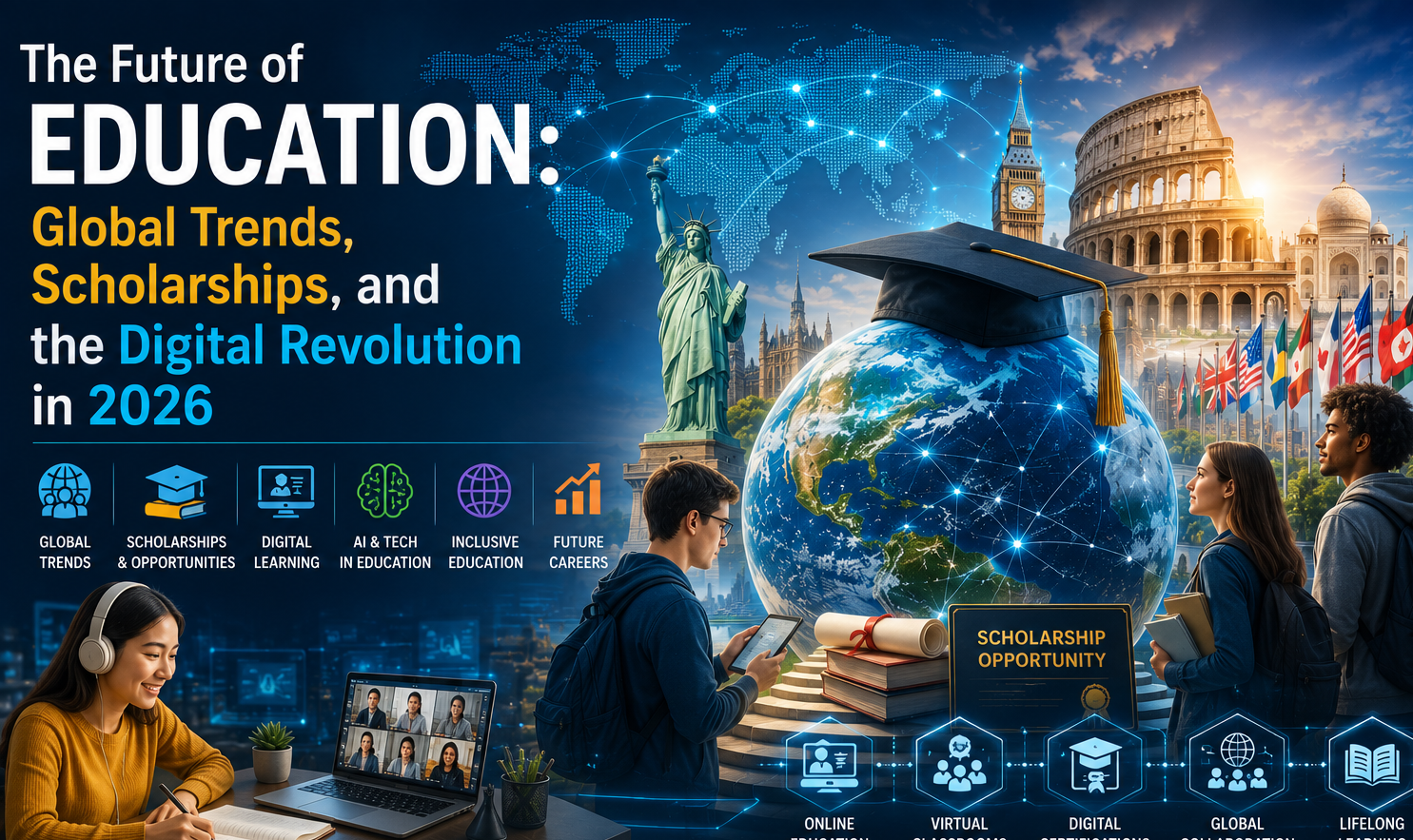
Education is no longer confined to the four walls of a classroom. In 2026, the global education landscape is undergoing a massive transformation, driven by artificial intelligence, borderless learning, and government-backed scholarship schemes. Whether you are a student looking to study abroad or a professional aiming to upskill, understanding these global shifts is essential for success.
This comprehensive guide explores the current state of global education, the best scholarship opportunities, and how digital platforms are democratizing learning for everyone, everywhere.
1. The Shift Toward Hybrid and Personalized Learning
The “one size fits all” approach to education is officially dead. Governments worldwide are now investing in Adaptive Learning Technologies.
- AI in Classrooms: Artificial Intelligence is now being used to create personalized lesson plans for students. If a student is struggling with Calculus but excelling in Literature, the system adjusts the pace of learning automatically.
- Hybrid Models: Universities in the USA, UK, and Australia have permanently adopted hybrid models, where theoretical lectures are delivered online, and campus time is reserved for practical labs and networking.
2. Global Scholarship Schemes for International Students
Finances are the biggest barrier to quality education. However, many governments offer fully-funded schemes to attract global talent.
The Fulbright Program (USA)
One of the most prestigious schemes in the world, the Fulbright program offers full funding for graduate study, advanced research, and university teaching. It covers tuition, airfare, and a living stipend.
Chevening Scholarships (UK)
Funded by the UK Government, this scheme targets future leaders. It covers a one-year Master’s degree at any UK university and is open to students from over 160 countries.
DAAD Scholarships (Germany)
Germany is a hub for international students because most of its public universities offer tuition-free education. The DAAD scheme provides monthly stipends to help with living costs for postgraduate students.
3. Vocational Training and the “Skills-First” Economy
In 2026, degrees are becoming less important than “proven skills.” Google, Apple, and Tesla have famously removed degree requirements for many technical roles.
- Micro-Credentials: Instead of a 4-year degree, students are opting for 6-month certifications in specialized fields like Cybersecurity, Data Analytics, and Renewable Energy Management.
- Government Skill Schemes: Countries like India (Skill India) and Singapore (SkillsFuture) are providing vouchers and grants to citizens to take these short-term courses, ensuring the workforce remains relevant in the age of AI.
4. The Rise of EdTech: Learning Beyond Borders
Digital platforms have made it possible for a student in a small village to learn from a professor at Harvard.
- MOOCs (Massive Open Online Courses): Platforms like Coursera, edX, and Udemy have partnered with top-tier universities to offer accredited degrees at a fraction of the cost.
- Virtual Reality (VR) in Education: In 2026, medical students are practicing surgeries in VR, and history students are taking virtual tours of ancient Rome. This “Immersive Education” is making learning more engaging and effective.
5. Studying Abroad: Top Destinations in 2026
Where should you invest your time and money?
- Canada: Known for its friendly post-graduation work permits (PGWP) and pathway to permanent residency.
- Germany: Ideal for STEM (Science, Technology, Engineering, Math) students due to zero tuition fees and high industry demand.
- United Arab Emirates (UAE): Dubai is emerging as an education hub with international branches of top UK and US universities.
- Nordic Countries: Finland and Norway remain leaders in “Innovation Education,” focusing on creativity rather than rote memorization.
6. Challenges in Modern Education
Despite the progress, the global education system faces significant hurdles:
- The Digital Divide: While urban areas enjoy 5G-enabled learning, rural parts of the world still struggle with basic internet access.
- Student Debt Crisis: In the United States, student debt has reached record highs, leading to a worldwide debate on whether higher education should be a “privilege” or a “basic right.”
- Mental Health: The competitive nature of modern exams and the isolation of online learning have led to an increase in anxiety among students, prompting schools to introduce “Wellness Schemes.”
7. How to Choose the Right Educational Path
If you are planning your future in 2026, follow this framework:
- Analyze Demand: Look for industries with a labor shortage (e.g., Green Energy, Healthcare, AI Development).
- Verify Accreditation: Ensure the online course or university is globally recognized.
- Check for Financial Aid: Never pay full price without checking for university-specific or government-funded scholarships first.
- Networking: Education is 50% knowledge and 50% who you know. Choose institutions with strong alumni networks.
8. Education for Sustainable Development (ESD)
Governments are now integrating “Climate Education” into school curriculums. The goal is to prepare the next generation to tackle global warming and resource scarcity. This is a huge “Scheme” area where many NGOs and governments are providing grants for research.
9. Conclusion
Education in 2026 is an exciting, fast-moving field. The barriers of geography and high costs are slowly crumbling, replaced by a system that values skills, flexibility, and global collaboration. Whether you are learning through a traditional university or a VR headset, the key is to remain a “Lifelong Learner.”