
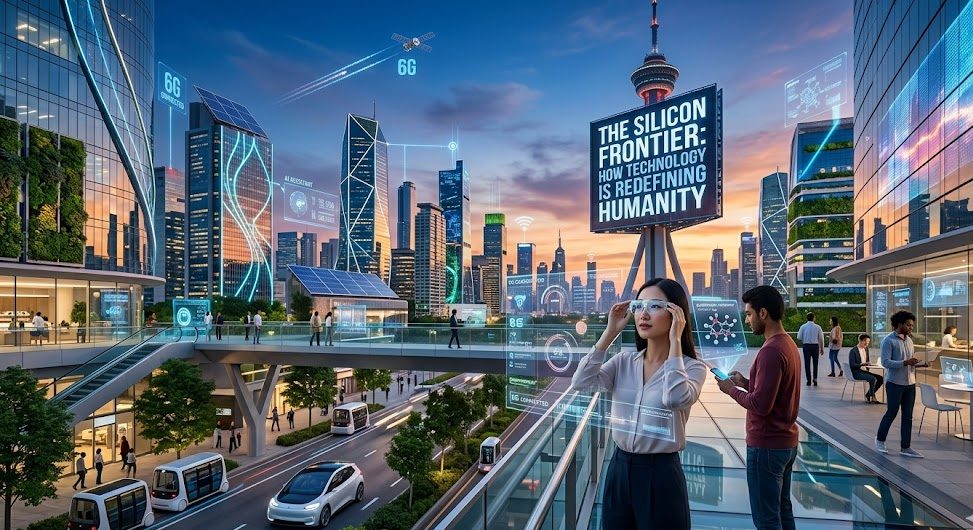
We are living in an era where the line between the physical and digital worlds has almost entirely evaporated. Technology is no longer just a “tool” we use; it is the environment in which we exist. From the way we work and communicate to how we solve global challenges like climate change and disease, technology is the primary driver of human evolution.
This article explores the most transformative technological trends of 2026 and how they are shaping our future.
1. The Era of Artificial General Intelligence (AGI) Foundations
While true AGI—AI that can perform any intellectual task a human can—is still a subject of debate, the systems of 2026 have reached a level of “Reasoning Intelligence.”
- Autonomous Problem Solving: Modern AI doesn’t just generate text; it creates multi-step plans to solve complex engineering and logistical problems.
- Personalized Digital Twins: Individuals now use AI “agents” that understand their preferences, manage their schedules, and even negotiate service contracts on their behalf.
- Hyper-Personalization: In content creation, AI allows for real-time adaptation, where a single video or article can morph to suit the specific education level and interest of the viewer.
2. The Quantum Leap: Computing at the Atomic Scale
After years of theoretical promise, quantum computing has entered the “Utility Phase.”
- Drug Discovery: Quantum processors can simulate molecular structures in seconds—a task that would take classical supercomputers centuries. This is leading to personalized medicine tailored to an individual’s DNA.
- Unbreakable Encryption: With the rise of quantum power comes “Post-Quantum Cryptography” (PQC), ensuring that global financial systems remain secure against new types of cyber threats.
- Climate Modeling: We can now simulate weather patterns with unprecedented precision, allowing for better disaster preparedness and more effective carbon capture strategies.
3. The Next Evolution of Connectivity: Beyond 6G
As 5G becomes the global standard, the first 6G pilot programs are beginning to emerge, promising speeds that make traditional fiber optics look slow.
| Technology | Latency | Primary Use Case |
|---|---|---|
| 5G | ~10ms | Mobile streaming, IoT, Smart Cities |
| 6G (Early) | <1ms | Holoportation, Remote Surgery, Terahertz Sensing |
| Satellite Internet | Variable | Global rural connectivity, Maritime logistics |
Export to Sheets
The integration of low-earth orbit (LEO) satellite constellations has effectively “killed” the dead zone, ensuring that every square inch of the planet has high-speed internet access.
4. Biotechnology and Human Augmentation
The boundary between biology and technology is blurring through breakthroughs in “Bio-Convergence.”
- CRISPR 2.0: Gene editing has moved beyond research to treating hereditary blindness and certain types of heart disease.
- Brain-Computer Interfaces (BCI): Non-invasive headsets now allow individuals to control software and robotic limbs with thought alone, providing a new lease on life for those with paralysis.
- Lab-Grown Everything: From “cultivated” meat that reduces the need for traditional livestock to lab-grown organs for transplant, bio-manufacturing is becoming a trillion-dollar industry.
5. The Green Tech Revolution: Solving the Energy Crisis
Technology is our best hope for a sustainable future. In 2026, “Green Tech” is the fastest-growing sector in the global economy.
- Next-Gen Batteries: Solid-state batteries have finally hit the mass market, doubling the range of electric vehicles (EVs) and charging in under 10 minutes.
- Nuclear Fusion Milestones: While commercial fusion is still on the horizon, recent breakthroughs in magnetic confinement have made “limitless clean energy” a scientific reality rather than a dream.
- Smart Grids: AI-managed power grids now redistribute energy in real-time, pulling power from millions of EV batteries during peak hours and recharging them when demand is low.
6. Cybersecurity in the Age of Deepfakes
As technology advances, so do the threats. The biggest challenge of 2026 is the “War on Truth.”
- AI-Driven Attacks: Hackers now use AI to create highly convincing phishing campaigns and voice clones.
- Zero-Trust Architecture: Modern organizations have moved away from traditional passwords. Security is now based on continuous biometric verification and behavioral analysis.
- Blockchain for Identity: Decentralized identity protocols allow users to prove who they are without sharing sensitive personal documents, putting the power of data back in the hands of the individual.
7. The Spatial Computing Revolution
The “Metaverse” hype has settled into a practical reality called Spatial Computing.
Instead of wearing bulky headsets to enter a virtual world, we use sleek AR (Augmented Reality) glasses that overlay digital information onto the physical world.
- Education: Students can “walk through” ancient Rome or look at a 3D model of a beating heart floating in their classroom.
- Remote Work: “Holoportation” allows team members from different continents to sit at the same table in a digital office, maintaining the nuances of body language and eye contact.
8. Ethical Implications and the “Digital Divide”
With great power comes great responsibility. The rapid pace of technological change has raised urgent ethical questions.
“The challenge is not just to build smarter machines, but to ensure that those machines serve a more equitable human society.”
- Algorithmic Bias: There is a global push for “Explainable AI” to ensure that automated decisions in hiring, lending, and law enforcement are fair and transparent.
- The Right to Disconnect: As work and life merge through technology, many countries are passing laws to protect workers from the “always-on” culture.
- Closing the Gap: While the developed world thrives on 6G and AI, the “Digital Divide” remains a threat. Tech giants and governments are now prioritizing “frugal innovation”—creating low-cost, high-impact tech for developing nations.
Final Thoughts
Technology in 2026 is no longer a separate vertical of industry; it is the horizontal layer that supports everything else. We are moving toward a future where technology is invisible, intuitive, and indispensable.
The success of the next decade will not be measured by how many transistors we can fit on a chip, but by how well we use those chips to solve the fundamental problems of the human condition. The future is not something that happens to us—it is something we are actively building with every line of code and every scientific breakthrough.
Key Trends to Watch:
- Decentralization: Power moving away from big tech to individual users via Web3.
- Circular Economy: Tech designed for 100% recycling and reuse.
- Ethical AI: The rise of the “Chief Ethics Officer” in every major corporation.
The digital frontier is vast and full of potential. Our task is to navigate it with both curiosity and caution.